
FILTRATION
Filtration is the separation of undissolved substances from liquids using a filter.
The undissolved substances may be present in particulate, colloidal, or dispersed form. The selection of the appropriate filtration method depends on the liquid medium as well as on the size of the substance to be separated.
The following diagram provides a rough classification of particle sizes.
The following sections focus exclusively on membrane technology.
Membrane filtration can be divided into four filtration stages, with the boundaries between them being fluid:
-
Microfiltration
-
Ultrafiltration
-
Nanofiltration
-
Reverse osmosis
We will examine all of the above-mentioned filtration methods.
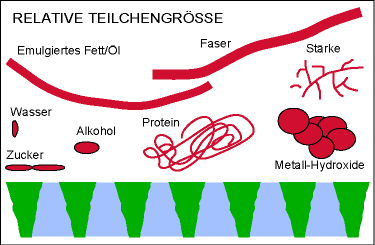
PARTICLE SIZE
To determine the appropriate process for separating different particles, it is not always sufficient to rely solely on tabulated or schematic values. Since the different membrane processes have overlapping separation ranges—which is also related to their varying definitions (e.g., defining the process based on pore size)—the actual physical characteristics of the particle must also be taken into consideration. Once the particle is known, the appropriate pore size can generally be determined reliably based on practical experience.
In practice, however, it is rare to encounter a process solution in which only a specific particle needs to be separated. Usually, a mixture of substances is present. Other substances contained in the medium may also interfere with the filtration process. It is therefore essential to know all components in order to make an accurate assessment. In practice, this is often not the case.
It is not always useful to remove all substances from the medium using a membrane. In some processes, it is even desirable for certain components to remain in the medium. Consequently, compromises often have to be found in practice. In addition, the energy consumption of the filtration system must be taken into account. In general, the purer the permeate (filtrate) is required to be, the more energy (pressure/crossflow) is needed. It should therefore be noted that the technically most effective process is not necessarily the best or most suitable option when considering the overall economic balance.
FUNDAMENTALS OF MEMBRANE FILTRATION
Membrane filtration uses a physical principle commonly found in nature: the transport of molecules through a semipermeable membrane caused by a pressure difference (transmembrane pressure). In this process, molecules or particles are retained by the membrane based on their size, weight, or structure.
The membrane is characterized by its pore size, the distribution of pores across its surface, the number of pores per m² of membrane area, its electrical charge, and its chemical composition. These factors, together with the filter cake (secondary layer) that forms during each filtration process, have a significant influence on mass transport. This, in turn, affects the yield, performance, and retention, and is therefore also a key factor in the economic efficiency of membrane filtration.
MEMBRANE and MODULE TYPES
Design, Structure and Materials
In general, a distinction is made between the membrane, which constitutes the actual filtration layer, and the housing, which contains the appropriately configured membrane. The module represents the complete unit and may consist of one or more membranes within a housing. Both the membrane and the module can be further classified according to their material and manufacturing method.
Membrane Materials
Membrane materials can be divided into two main groups: organic membranes (polymers) and inorganic membranes (ceramic, metallic, and carbon-based membranes). However, metallic membranes are of virtually no economic significance in practice.
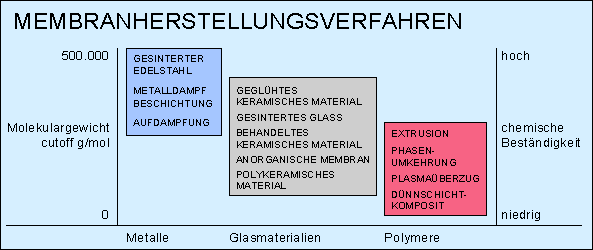
Both types of membranes have a wide range of applications in industry. In general, however, inorganic membranes play a relatively minor role due to their high cost and comparatively large pore sizes. It should nevertheless be noted that ceramic membranes are preferred in certain applications, particularly where their specific advantages can be fully utilized.
The market for ceramic membranes is primarily concentrated in Europe, especially in Germany. Internationally, inorganic membranes are of relatively little significance. Most ceramic membranes are used for microfiltration.
FUNCTION
Molecular Sieve Filtration
Microfiltration and ultrafiltration, which will be examined in more detail below, belong to the category of molecular sieve filtration processes. The medium to be filtered is applied to the membrane under pressure and flow. Substances that cannot pass through the pores due to their size, structure, or charge remain in the concentrate. The driving force for this process is a pressure of 2–10 bar.

Diffusion Filtration
Osmosis and reverse osmosis are based on the principle of diffusion filtration. In this process, the solvent diffuses into the membrane depending on the membrane’s structure and chemical composition and is then released again on the permeate side. This type of membrane has no pores. The driving force is either a concentration gradient (osmosis) or an external pressure of 10–50 bar (reverse osmosis).
Triebkraft ist entweder ein Konzentrationsgefälle (Osmose) oder ein äußerer Druck von 10– 50 bar (Umkehrosmose).
The Cross-Flow Principle
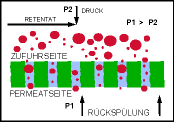
In membrane filtration, a filtrate is generally removed from the feed stream. It passes through the membrane and is discharged via a permeate collector. The retentate remains in the flow channel, and its concentration continuously increases throughout the filtration process.
In membrane filtration based on the cross-flow principle, the feed flows tangentially across the membrane surface. The resulting turbulent flow conditions prevent excessive or inhibiting deposits from forming and instead promote the formation of a controlled secondary layer. This makes it possible to operate this type of filtration continuously.
Bei der Membranfiltration nach dem Cross-Flow-Prinzip wird die Membran tangential angeströmt, so dass aufgrund der sich einstellenden turbulenten Strömungsverhältnisse keine hemmenden Ablagerungen, sondern vielmehr eine kontrollierte Sekundärschicht gebildet wird. Dadurch wird es möglich, diese Art der Filtration kontinuierlich zu betreiben.
The advantage of cross-flow technology is that high cross-flow velocities can be achieved. The high flow velocities and strong turbulence at the membrane surface minimize the formation of the filter cake, resulting in only a limited decrease in flux over time. The filter cake forms as a result of concentration polarization at the membrane surface. The solvent passes through the pores and is removed as permeate, while the concentrated material is retained at the membrane surface.
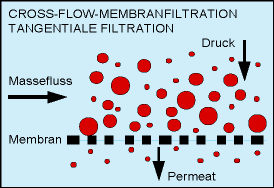
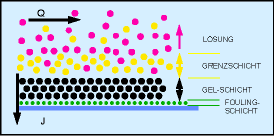
In many separation processes, the formation of a filter cake (secondary layer) is necessary to achieve the desired results. The secondary layer supports the actual filtration process by acting as a type of pre-filtration and reducing the load on the pores. Theoretically, a continuous cycle of formation and removal of this secondary layer would be possible. In practical applications, however, this cannot be achieved without limitations, as the rate of layer formation is generally greater than its removal. Consequently, membrane cleaning becomes unavoidable after a certain period of operation.
Cleaning
The service life and overall lifetime of membranes are of great economic importance. However, they can be significantly extended through optimized cleaning. In general, two types of cleaning can be distinguished.
Chemical Cleaning
In chemical cleaning, once the filtration performance of the system has decreased, a flushing process is carried out using a chemical solution. Depending on the medium being filtered, the solution may be alkaline or acidic. The solution is circulated across the membrane for a defined period of time using a circulation or flushing pump. The filter cake that has formed is chemically removed from the membrane. Part of the cleaning solution penetrates the membrane pores and dissolves any particles that may have accumulated there. After cleaning has been completed, the cleaning solution must be discarded. If the desired flux is not restored, the cleaning process must be repeated.
Permeate-Side Backwashing
During permeate-side backwashing, the permeate is returned against the normal flow direction at defined intervals during the filtration process. This is carried out using air or a water reservoir, whereby the backpressure must be greater than the filtration pressure. This type of cleaning is used only with certain module types, as not all membranes are mechanically stable enough to withstand backwashing. It is particularly useful for symmetric membranes, as filtration takes place within the pores of these membranes.
Bei anorganischen Membranen ist die permeatseitige Rückspülung in der Praxis eine Notwendigkeit, da diese eine symmetrische Pore haben. Weiterhin ist diese Reinigung bei der Mikrofiltration, wo man aufgrund der grösseren Pore eher in der Pore als auf der Deckschicht (UF) arbeitet, anzuraten. Bei organischen Membranen, hingegen, wird diese Reinigung eher selten eingesetzt. Grundsätzlich muß angemerkt werden, daß diese Art der Reinigung in der Praxis nicht immer den gewünschten Erfolg zeigt, zumal sie zusätzlich auch noch energetisch relativ aufwendig ist. Jeder Reinigungsvorgang ist also einzeln und auf den spezifischen Anwendungsfall abgestimmt zu betrachten.